
The Winter Masquerade
Marble III | The night nobody was supposed to leave.

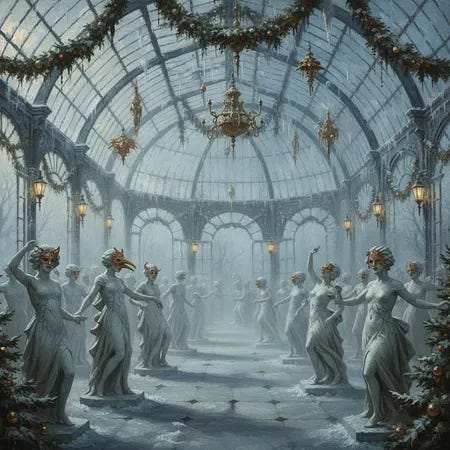
The City, first winter.
From the Conservatory Charter, Article VII:
Movement is permitted only when it improves the record.
The invitation arrived on time, which meant I was already late.
It reeked of formaldehyde. Only matters that ran on a schedule this unforgiving smelled that awful. A lion biting its own tail glowered on the seal, an ouroboros with severe dental issues (which I understood completely).
Inside, the instructions:
You are ordered to present yourself to the Winter Masquerade.
This moment will be preserved forever.
Your cooperation is mandatory.
The word ‘preserved’ concerned me. People usually applied it to peaches or corpses, neither boding well for a social event. Which was why it boded perfectly for this one.
I was free to decline, of course. The option was not renewable.
But I am the Archivist. Observe. Record. Never be worth a wall.
I had to go.
If I didn’t, I wouldn’t be the Archivist anymore, and an Archivist who isn’t an Archivist has no job, and a man without a job is a man without an invitation.
And I had an invitation.
Snow fell in lazy clumps—plop plop—as if the sky were coughing after a particularly embarrassing dinner, and I congratulated it on having at least some theatrical sense.
The streets were clogged with revelers, laughing the required, manic laughter of people who had paid too much for their masks to admit discomfort—a violation of the Discomfort Admittance Act of 1843. Evergreen garlands had been nailed along iron railings and shopfronts, already browning at the edges.
A man in a wolf mask barked at me. It was permitted, provided he had the proper permit. I didn’t bark back, which made me the aggressor. In a city of wolves, the one who refuses to bark is the only one making noise.
A woman in a peacock mask tried to bite someone’s ear—an unsanctioned use of the mouth, but a sanctioned use of the teeth—so the matter went to a subcommittee.
A couple danced in a fountain, screaming, “We are timeless!” even though the water was visibly freezing around their legs. They believed that if they ignored the clock, it would be forced to ignore them, which is the kind of logic that only works until you lose a toe to frostbite.
I jotted an arrow in my notebook: Timeless, yes. Also slightly damp, very stupid, entirely hilarious.
A crow protested in squawks. A fair complaint.
I tightened my scarf and headed to the Conservatory, our winter cathedral of glass, where life become art against its will.
The Conservatory had been dressed for the season with a generosity usually reserved for holidays and state funerals: gilt everywhere, greenery everywhere, and not a living thing allowed to wilt.
The interior met the official temperature requirements, providing a warmth adequate for sweating. It would have been pleasant if not for the smell: heavy, syrupy, slightly criminal perfume of poppy and mold. It was the smell of something kept alive long after it had the decency to die, which was, of course, the primary function of the Conservatory.
My gloves wrinkled in disapproval. I noted: Air ambiguous. Possibly plotting minor mutinies.
Mirrors lined the ballroom, gossiping fiercely, bending reflections like taffy, stretching heads to obscene heights, shrinking torsos to ridiculous minuscule. One particularly ambitious mirror elevated my head three feet above its proper perch; I bowed, thinking it might be impolite not to, and wrote: Excellent elevation. Head feels substantial.
Then, I attempted to exercise my right to witness without fulfilling my obligation to be witnessed.
But the crowd applauded.
They applauded because they were beholding a “Visual Discontinuity,” and according to the program, a Visual Discontinuity required a minimum of three seconds of hand-clapping. If I told them my head was actually attached to my body, they would have called me a liar. If I proved my head was attached to my body, they would have called me a failure. I was caught in the Archivist’s Dilemma: I had to be seen to exist, but if I was seen as I was, I vanished from the record.
As the applause ran its mandated course, I noticed my raised hand remained raised.
It took longer than expected to lower it.
The musicians performed the preliminary tuning procedure with the solemnity of men scheduled for execution. The violinist appeared partially embalmed, likely a requirement of his contract. He was either a very dedicated artist or a very well-preserved corpse, and in the Conservatory, there was no legal distinction.
A dancer brushed past me, smelling of cheap powder and exertion, a flagrant violation of the Olfactory Policy (Sub-section 4: Floral Standards). Her steps didn’t align with the music; her laughter was an unrecorded outburst. When she tripped, she offered no apology to the floor, but laughed and made a theatrical bow.
For a moment, her reflection blurred, as if the glass had lost interest. It sharpened again on someone else.
The Dancer looked at it as if wondering which one of them was the redundancy. She shrugged. After all, if the mirror was satisfied, the Conservatory was satisfied.
She continued to dance.
Then I saw him: Edmund Cravenmoore.
The Conservatory was slow to act on anything it hadn’t yet agreed on how to classify. Attaching myself to him seemed a way to share in that delay.
He wore his ancient tragedian half-mask, which was a useless gesture, since his face was already a mask of a man trying to remember a face.
“Archivist!” he shouted, waving a handkerchief with a suspicious brown stain—blood? tea? past regrets? All were valid archival materials. “You’re here to write our elegy! Make it legible!”
“If it’s legible, it isn’t an elegy,” I told him. “And if it’s an elegy, it’s because you’re already dead. Since you’re still talking, I can’t write it. If I write it, you have to die.”
He adjusted his cuffs. “I can’t be dead. I haven’t seen the paperwork yet. And since you write the paperwork, and you’re still talking to me, you haven’t written it. Therefore, I am immortal until you stop being polite.”
It was a flawless argument.
I positioned myself at the edge of the room, where reflections thinned and applause arrived late. If I could not disappear, I could at least be peripheral. Being peripheral was a legal loophole; it meant I was technically present but legally absent.
Every guest was performing: the wolf-masked man bowed to a lobster, the peacock-masked woman conversed with the ceiling, masks stacking on masks, feathers and beaks and horns multiplying geometrically. I recorded it all, with footnotes and occasional sighs of admiration.
A steward tapped my shoulder. “Peripheral standing is reserved for reflective anomalies.”
“I am an Archivist,” I said. “Archivists are, by definition, anomalous.”
He consulted a small card and frowned. “The memorandum on anomalous standing is clear: visibility improves the record. An invisible record is an unrecorded record, and an unrecorded record is a violation of the Archival Code. If you remain peripheral, you are technically not an Archivist, and if you are not an Archivist, you are trespassing.”
“I am observing.”
He shook his head. “Observation requires confirmation.”
Two more stewards appeared, smiling with the patience reserved for uncooperative furniture. I was placed three steps forward, into the mandatory light.
“Thank you for your cooperation,” the steward said, which meant the matter was closed.
Then the Host arrived.
He was tall, immaculate, and entirely redundant. His eyes were polished bone where pupils should be, as if sight had already been ruled unnecessary.
“My friends,” he said, “tonight you will meet yourselves. And if you’re lucky, survive the introduction.”
The crowd applauded. Applause was mandatory.
The music started, both loud and soft, fast and slow, depending on which form you filled out. Masks flashed. Bodies whirled. The room rotated exactly three degrees counter-clockwise, an officially approved architectural adjustment.
Then—the first scream.
It didn’t sound like terror. It sounded more like someone realizing their soufflé had collapsed: a culinary disaster of the highest order, an error in preservation.
In the Conservatory, an expired soufflé was a far worse offense than sudden death.
The Subject—formerly a woman, currently a swan—spun toward the mirror. Her reflection was too luminous to be sane, the sort of self-image one might hallucinate after three opium pipes.
She reached toward that beautiful phantom self, hoping to touch the lie before it became the truth. Instead, the truth touched her back: she turned to stone mid-gesture.
It was an efficient transformation. There was no paperwork involved, which was the most miraculous part of all.
The crowd roared with applause.
“Bravo!” someone shouted.
“A masterpiece!” cried another.
“Is she for sale?” asked a third.
I approached the Subject for inspection. The stone was warm, a clear violation of the Conservatory’s cooling statutes. Under the surface, I heard her breathing: a shallow trapped-bird sound that indicated she was still very much alive and very much suffering.
I wrote in my ledger: Subject remains conscious.
I stared at the sentence.
It was a problematic entry.
To report her consciousness would be to report a defect in the art. It would be a rude detail, a bureaucratic hiccup in an otherwise flawless evening. Being conscious while being a statue was a clear case of Double Occupancy, and she didn’t have the permit for both.
I crossed out the line. Being conscious was a private matter, and it was highly unprofessional of her to involve me in it. If she wanted to be breathing, she shouldn’t have reached for a lie. If she wanted to be beautiful, she had no business breathing.
I moved on.
The ball began to unravel.
A pair of lovers froze while kissing, forever locked in a moment of affection so forced that it bordered on assault. It was an efficient way to solve their relationship issues; you cannot have an argument if your vocal cords are marble.
A noblewoman attempted a curtsey and became a decorative pedestal.
A man removing his gloves became a glove rack, a rare instance of a human being finally achieving his true vocational potential.
Everyone was becoming purposeful, and in this city, being purposeful was the only way to be excused from being alive.
The musicians slowed, not out of fatigue, but out of solidifying policy. The viola player’s elbow calcified mid-stroke, leaving him to complete the symphony with just passive-aggressive eye contact.
The poppy smell spread until the walls no longer felt still. This violated the building code—walls are supposed to be inanimate—but since the people were becoming inanimate, the walls had to pick up the slack to maintain the room’s metabolic average.
Edmund leaned in. “They do love an encore,” he whispered.
Then he recited a line I recognized from a forbidden play: “Vita mutatur, non tollitur!”
I noticed the crest on his handkerchief: the Ouroboros, the lion with dental issues matching the one on my invitation. It was also on the playbills from the “Cravenmoore’s Vanishing Remorse” twenty years ago, when the illusion worked so perfectly that no one involved was ever permitted to reappear.
The logic closed in on me like a filing cabinet.
If the crest was the same, the invitation wasn’t a request; it was a subpoena. And if I was here to archive the catastrophe, I was part of the catastrophe, because an archive without a catastrophe is just an empty shelf, and the Conservatory had a zero-tolerance policy on empty shelves.
I tried to note it down, but my pen’s weight had doubled. A clear case of accelerated material change. I wasn’t sure whether the ink was coagulating or I was.
“Mr. Cravenmoore,” I said, “was the Vanishing Remorse a failure of your illusions or a success of the Archive?”
“It was a triumph of filing,” Edmund said. “They vanished so immaculately that any reappearance would have been a waste of breath. So they were filed away. Just like we’re being filed now. You aren’t here to write history. You are the history. And history is what happens to people who are no longer present to complain about it.”
I cornered the Host near a pillar shaped like a weeping angel. It was so realistic I suspected it had recently been a person who asked too many questions.
“Why?” I demanded.
“Because,” he said, smiling with teeth as white and lifeless as the floor, “beauty is a fleeing deer. And I prefer my deer gutted and mounted where they can’t run. If a deer is running, you can’t see it properly. If you can’t see it properly, it isn’t truly beautiful. Therefore, for a deer to be beautiful, it must be prevented from moving.”
This was not comforting. It was, however, logically sound, which was much worse: it left no room for the deer to be a deer.
He lifted the chin of a newly frozen dancer with the tender care of a taxidermist. “Look how exquisite she is. Not a single flaw. Time can’t touch her now. She has achieved the ultimate goal of every living thing: she has stopped being bothered by life.”
“But she’s alive,” I whispered.
“Briefly,” he said. “We hope. It makes the sculpture authentic. If she weren’t alive, the stone would be a lie. If she is alive, the stone is truth. Since you are the Archivist, you must decide: a living lie or a dead truth?”
“I’d prefer a living truth,” I said.
“Impossible,” the Host smiled. “A living truth is a contradiction. The moment a truth lives, it changes. The moment it changes, it’s no longer the truth you recorded. To be true, it must be static. To be static, it must be stone.”
I made a mental note to resign after the event. But to resign I had to survive it. To survive, I had to remain the Archivist. The Host allowed only Archivists to witness the transformation without participating. If I resigned, I was no longer a witness but a Subject. And Subjects were never allowed to leave.
The only way to stay alive was to keep my job, but to keep my job I had to watch everyone else die. If I stayed, I was an accomplice. If I left, I was a statue.
“You look troubled,” he said, patting my ledger. “Don’t be. You’re doing a marvelous job. Keep writing, or I might think you’re bored. And I have a very irrevocable cure for boredom.”
I kept writing. I wrote that the stone was perfection. I wrote that the dancer was lucky. I wrote that the deer was safe from the forest. It was the only way to ensure the hand holding the pen didn’t turn into the hand holding a pose.
The Dancer collided with me. Her mask cracked, her movements chaotic, her very presence a total violation of the ballroom’s mandatory grace.
She was the only one dancing ugly. She stumbled, flailed, laughed.
“That’s the trick,” she gasped, her breathing loud. “Imperfection! They freeze when they see themselves perfect. Don’t let the mirror catch you! The Conservatory doesn’t collect trash. So be trash!”
Then I saw it.
My reflection.
And the reflection was a lie I wanted to believe.
It was not me as I was—a man whose spine was a question mark and whose clothes smelled of ink. It was me as I should have been: confident, posture straight, chin lifted. A version of myself who had not spent years documenting a society rotting from its own self-regard.
I lifted my hand.
Numbness tingled up my wrist. My veins silvered. I was being preserved, the very thing I had been invited to witness. I was finally becoming a valuable member of the community by ceasing to be a member of the living.
“Join the gallery, Archivist,” the Host murmured. “We need someone of your standing. Preferably permanent.”
Then the Dancer slapped me. The pain was sharp and entirely unauthorized.
“MOVE, you idiot!” she screamed.
I didn’t just move; I failed to stand. I tripped over my own feet, my limbs tangling in a display of physical incompetence that defied every law of composition. I was no longer a masterpiece. I was a smudge. A typo.
The numbness vanished. The mirror had no legal jurisdiction over a man face-down on the floor.
I sat and opened my ledger. Saved by ineptitude, I wrote. I underlined it twice. In a city where following the rules led to a marble pedestal, the only way to remain human was to be a total, unmitigated screw-up.
The Host looked disappointed. I had failed to meet my potential.
Morning light crawled into the Conservatory with the apologetic air of an unfiled petition, uncertain if it could exist on the premises where the shadows were so heavily guarded.
Everything glittered. The hundreds of new statues were coated in fine ice-dust, arms raised and eyes wide in expressions of eternal ecstasy—or eternal agony. The distinction had been abolished by a three-to-one vote two weeks prior.
The reporters arrived first, followed closely by the Council members, who moved through the room with radiant, self-congratulatory pride, having reduced the city’s healthcare costs while doubling its tourist attractions.
“Exquisite,” the Chairman noted, checking a box on a clipboard. “It’s the most orderly crowd in the history of the city. Usually, citizens have the gall to move.”
It was particularly gauche to mention the muffled, rhythmic thumping coming from inside the marble pedestals. The Council had officially redefined ‘breathing’ as ‘Structural Settling,’ and structural settling was to be expected in a building of this age. To hear a heart beating was to admit to hallucination; to report it was to admit to insanity.
I checked my hands. They were still hands. I flexed my fingers. Nothing calcified. Not yet.
The ledger lay heavy in my lap, as if remembering everything I had written and waiting to see if I would dare add more.
I sat down to finalize the official record.
If I wrote that the Host was a murderer, I would be noticed.
If I wrote that the guests were victims, I would be noticed.
Being noticed was how it started.
So I wrote carefully:
A night of unparalleled artistic triumph.
Participants embraced eternity voluntarily, as evidenced by their refusal to leave.
The Host graciously abstained from commentary.
My pen hesitated. In the margins, where the paper was too thin for the Law to stand on, I scratched a single line:
Life is only beautiful when it is allowed to be ugly.
With that notation, anonymity no longer applied. The record now contained a deviation.
A deviation, once entered, required immediate classification.
The Host approached.
I lifted the pen—
The Council recorded the event as a cultural success.
Citizen mobility decreased significantly that night.
Cycle I—Origin.
The City discovered that perfection was easier than mercy.
This story has a second voice.
It answers in Ember, where the cost of preservation is named directly.
If you enjoyed this Gothic short story and want more dark fantasy fiction, Marble & Ember continues every week.
- 🜛 Angela
Marble & Ember
I can’t decide whether to congratulate on the language, argue that this was all wonky for no other reason than to drive the reader mad, or to not comment because I probably didn’t get what this was about… so all of them at once I suppose, like a good contradiction.
Well done, and I’m amazed by your voice here!
This was absolutely incredible.
One of the most poignant and creative pieces of commentary and personal insight on our society I have read.
Truly, standing ovation.